
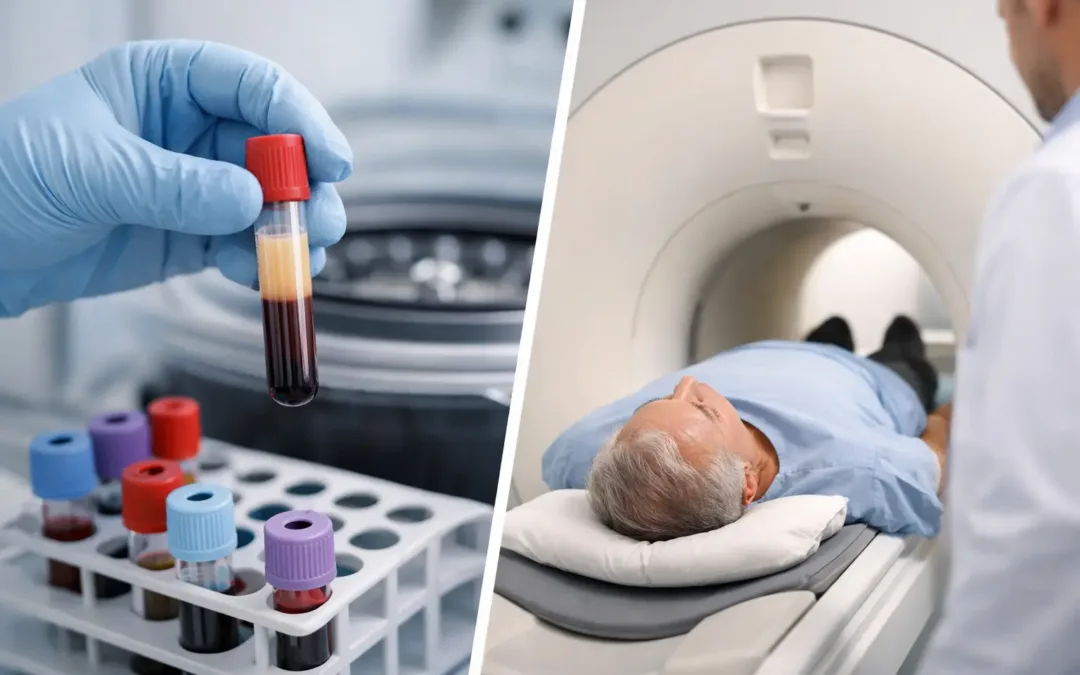
A high PSA result can hit hard, especially when you feel completely fine. But PSA versus MRI is not really a contest between two prostate tests. They answer different questions, and understanding the difference can help you have a calmer, more productive conversation with your doctor.
For most men, PSA is the first signal. An MRI is often the next-level tool used to look more closely when that signal needs an explanation. Neither test can tell the whole story alone, but used in the right order, they can reduce uncertainty and help avoid unnecessary procedures.
PSA versus MRI: The core difference
A prostate-specific antigen, or PSA, test is a simple blood test. PSA is a protein made by prostate tissue, and small amounts normally circulate in the bloodstream. Higher levels can be associated with prostate cancer, but cancer is far from the only cause.
An MRI, usually called a multiparametric MRI or mpMRI, is an imaging scan that creates detailed pictures of the prostate. It does not measure PSA. Instead, it looks for areas in the gland that appear more suspicious for clinically significant cancer - cancer more likely to grow, spread, or require treatment.
Think of PSA as an early warning light on your dashboard. It can tell you that something may deserve attention, but it cannot tell you exactly what is causing the warning. MRI is more like opening the hood for a closer look. Even then, a scan may point to a suspicious area, but a biopsy is generally needed to diagnose cancer for certain.
What a PSA test can and cannot tell you
The main advantage of PSA testing is that it is fast, widely available, inexpensive compared with advanced imaging, and useful for tracking changes over time. It can help identify men who may benefit from additional testing before they develop symptoms.
The limitation is that PSA is not cancer-specific. Levels can rise for several reasons, including benign prostatic hyperplasia, or BPH, which is a noncancerous enlargement of the prostate. Prostatitis, a urinary infection, recent ejaculation, vigorous cycling, urinary retention, and recent prostate procedures can also affect the number.
Age and prostate size matter, too. A PSA level that causes concern in a younger man may be less concerning in an older man with a larger prostate. Rather than reacting to one number in isolation, clinicians consider your age, family history, race, prior PSA results, medications, urinary symptoms, and prostate exam.
A rising PSA can matter, but it is not automatic proof of cancer. If a result is unexpectedly elevated, your clinician may repeat it after addressing possible temporary causes. This is a practical step that can prevent a single abnormal result from sending you straight toward invasive testing.
What a prostate MRI adds
A prostate MRI provides anatomy that a blood test cannot. Radiologists review the scan for areas that may have features associated with significant prostate cancer and assign a suspicion score, commonly using the PI-RADS system. Scores generally range from 1 to 5, with higher scores indicating a greater likelihood that a concerning lesion is present.
MRI can be especially useful when PSA is elevated but the next step is unclear. If the scan finds a suspicious area, it gives the urologist a target for a more precise biopsy. Instead of relying only on standard sampling throughout the prostate, a targeted biopsy can focus on the area that needs the closest evaluation.
A reassuring MRI may also help some men avoid an immediate biopsy, depending on their PSA level, PSA density, family history, exam findings, and overall risk. PSA density compares the PSA level with prostate volume measured on imaging. A larger prostate can produce more PSA, so this calculation can add helpful context.
MRI has other advantages. It uses no ionizing radiation, unlike a CT scan, and it may help assess men who have had a prior negative biopsy but still have concerning PSA results. It also plays a major role in active surveillance, where men with certain low-risk prostate cancers are monitored carefully rather than treated right away.
When MRI does not replace PSA
MRI is powerful, but it is not a universal prostate cancer screening test. It costs more, takes longer, may not be easily available in every community, and can create its own uncertainty. Some suspicious-looking areas turn out to be benign, while some cancers - including a small number of significant cancers - may not be obvious on a scan.
That is why a normal MRI does not always end the conversation. A man with a strongly elevated or steadily rising PSA, a concerning rectal exam, or major inherited risk may still need a biopsy even if the MRI does not show a clear target.
MRI can also be challenging for men with severe claustrophobia or certain implanted devices, although many modern implants are MRI-compatible. Some MRI protocols use contrast material, while others may not. Your imaging center and urologist can explain what your scan involves and whether any preparation is needed.
Which test usually comes first?
For a man without a known prostate cancer diagnosis, PSA typically comes first because it is practical for screening and risk assessment. The decision to begin PSA screening should be individualized. Many men start discussing it in their 50s, while those with a father or brother with prostate cancer, multiple affected relatives, certain inherited genetic risks, or Black men may benefit from starting that conversation earlier.
If the PSA is elevated, the next move is not automatically an MRI or a biopsy. Your clinician may repeat the PSA, check for infection or other temporary factors, perform a digital rectal exam, or use a risk calculator. If concern remains, an MRI can help determine whether biopsy is appropriate and how it should be performed.
For men already diagnosed with prostate cancer, the sequence changes. PSA becomes a key monitoring tool, while MRI may be used to clarify findings, guide biopsies, support active surveillance, or help plan treatment. The right plan depends on the grade and location of the cancer, PSA pattern, health status, and personal priorities.
How to prepare for a better PSA conversation
Do not try to self-diagnose from a PSA number on a lab portal. Instead, go into your appointment ready to give your doctor context. Mention urinary symptoms, pelvic pain, fever, recent infections, ejaculation or hard cycling in the day or two before testing, medications, and any close relatives with prostate, breast, ovarian, pancreatic, or colon cancer.
Ask whether your PSA should be repeated before moving forward. Ask what your PSA density is if you have had imaging. If MRI is recommended, ask how the result could change the decision about biopsy. These questions shift the conversation from fear to a clear plan.
Also remember that prostate cancer often causes no early symptoms. Trouble urinating, weak flow, frequent nighttime urination, or erectile changes are common concerns worth discussing, but they are more often linked to BPH, medication effects, vascular health, or other noncancerous causes. Still, blood in the urine or semen, unexplained bone pain, significant weight loss, fever with urinary symptoms, or an inability to urinate deserve prompt medical attention.
The decision is about your risk, not just your result
The best choice is rarely PSA alone or MRI alone. It is a risk-based decision built from both tests when needed, plus your medical history and goals. A younger man with a strong family history may reasonably take a more proactive approach than an older man with serious health conditions and a mildly elevated PSA that has been stable for years.
You do not need to choose between being vigilant and being rational. Get the information, ask what is driving your risk, and make the next decision with your clinician one step at a time. That is how you protect both your prostate health and your peace of mind.
This article contains general information about medical conditions and treatments. The information is not advice, and should not be treated as such. Click here for further information.

