
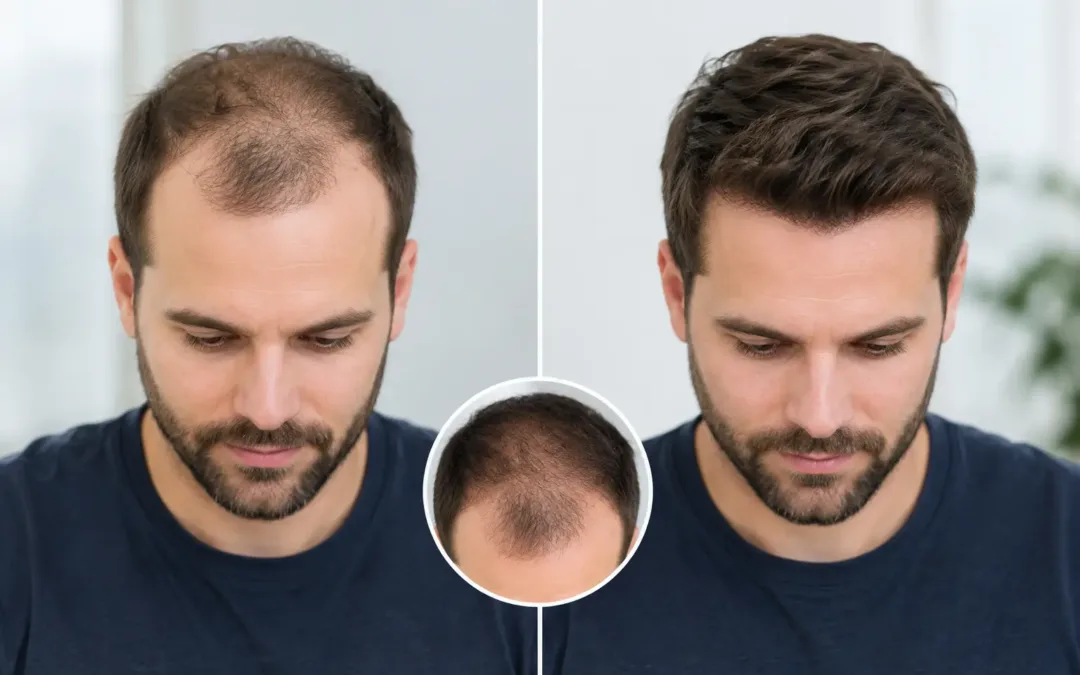
At 42, Marcus had stopped volunteering to be in photos. His recession had begun in his early 30s, but the thinning at the crown became harder to ignore after 40. He was healthy, active, and not looking for a dramatic new hairline. He wanted to look more like himself, without creating a result that looked obvious five years later.
This hair transplant case study follows a realistic composite patient journey, based on common clinical planning principles and recovery patterns. It is not a promise of results. Hair loss, donor supply, healing, and long-term progression vary from man to man.
The Starting Point: Hair Loss, Goals, and Donor Supply
Marcus had a Norwood 4 pattern: deep recession at both temples, diffuse thinning through the frontal third of his scalp, and a developing crown. His sides and back still had good density, making him a potentially suitable candidate for a follicular unit extraction, or FUE, procedure.
The consultation mattered more than Marcus expected. A reputable hair restoration physician did not simply ask how many grafts he wanted. The discussion covered his family history, the speed of his hair loss, current medications, scalp health, blood work when appropriate, and whether his donor area could support both the current procedure and possible future needs.
That last point is where many men get into trouble. A transplanted hairline can look strong in the short term but become unnatural if native hair continues to thin behind it. Marcus's father and older brother both had advanced hair loss, so the plan had to preserve donor grafts and avoid a low, dense hairline designed for a 25-year-old.
His goal was practical: restore the front enough to frame his face, add density behind it, and make the crown less noticeable. He was comfortable using medical treatment to help slow further loss, provided his physician agreed it was appropriate for him.
Why the Plan Was Conservative
Marcus was offered an estimated 2,400 to 2,700 grafts. Rather than spread those grafts evenly across every thin area, the surgeon recommended prioritizing the frontal hairline and mid-scalp. The crown would receive lighter coverage.
This is a key lesson from any useful hair transplant case study: grafts are limited. A single graft may contain one to four hairs, but a finite donor area cannot provide unlimited density. Placing too many grafts in the crown can leave too little supply for the front, which usually has a greater effect on how a man looks face-to-face.
The proposed hairline also sat slightly higher than Marcus initially imagined. The surgeon explained that mature, age-appropriate design generally holds up better as hair loss progresses. Marcus chose a subtle irregularity at the hairline rather than a perfectly straight edge, which helps results appear more natural.
After reviewing the trade-offs, he booked an FUE procedure for 2,580 grafts. About 1,650 grafts were assigned to the frontal zone, 680 to the mid-scalp, and 250 to the crown transition. The remaining variation reflected graft quality and surgical judgment during the procedure.
Procedure Day: What Actually Happened
Marcus arrived with his hair trimmed short and ate a light breakfast as instructed. The clinic used local anesthesia, so he remained awake but comfortable. Most of the day involved removing individual follicular units from the donor area, creating tiny recipient sites, and placing grafts according to the hairline design.
The procedure took roughly eight hours, including breaks. He watched movies, ate lunch, and felt pressure and occasional brief discomfort during numbing injections. He did not feel the graft placement itself.
FUE appealed to Marcus because it does not leave the long linear scar associated with follicular unit transplantation, or FUT. That did not mean it was scar-free. FUE creates many tiny circular scars that are usually difficult to see once the hair grows out, but they can be more visible if a man shaves his head very closely or if too many grafts are removed from one area.
He left with a bandage around the donor region, written aftercare instructions, pain medication if needed, and a clear warning: the next few weeks would look worse before they looked better.
Recovery: The Part Social Media Often Skips
For the first three nights, Marcus slept with his head elevated to limit swelling. He used a saline spray as directed and avoided touching or rubbing the grafts. By day four, small scabs had formed across the recipient area. The donor region felt tight and tender, similar to a bad sunburn.
At work, he used a loose hat after his surgeon cleared it. He avoided strenuous exercise, swimming, alcohol, and direct sun exposure during the early recovery period. Those restrictions were temporary, but they required planning. Men who have physically demanding jobs or frequent travel should build that downtime into their decision.
By day 10, the scabs had washed away with gentle shampooing. The redness faded over the following weeks, though it lasted longer in some spots because Marcus had fair skin. At two weeks, the transplanted hairs began to shed. This is normal shock loss, but it can be unsettling if you are expecting immediate growth.
Marcus also experienced temporary shedding of some existing hairs near the transplant area. Native hair can be sensitive to the trauma of surgery, especially when it is already miniaturized. In his case, much of it recovered over the next several months. That outcome is common, but not guaranteed.
Month-by-Month Results
At three months, Marcus had little visible improvement. Fine new hairs were starting to emerge, but they were sparse and uneven. This was the period when patience mattered most. He continued his physician-approved hair-loss plan and focused on sleep, protein intake, and keeping his scalp protected from sunburn.
At six months, the change became noticeable. His frontal hairline had softened his appearance, and he could style his hair forward and slightly up without exposing the recession as much. The crown still looked thin under bright overhead lighting, but it was less pronounced.
At nine months, the new hairs had become thicker and darker. His barber could blend the donor area with a shorter fade, and Marcus no longer felt the need to position himself carefully in group photos. More importantly, the result did not look like a sharp, artificial wall of hair. It looked like he had better coverage.
At 12 months, the clinic considered the frontal and mid-scalp results close to mature. Marcus had visible density through the front, a conservative but credible hairline, and improved coverage in the crown transition. He did not have the density of his teenage years, and he understood that was never the realistic target.
The crown was still the weakest area. His physician explained that crown grafts often take longer to mature and that ongoing hair loss could change the picture over time. A second procedure might be an option later, but only if his donor supply and future pattern justified it.
Cost and Long-Term Maintenance
Marcus paid approximately $14,000 for the procedure, including surgical fees and follow-up visits. Pricing varies widely by region, clinic reputation, surgeon involvement, technique, and graft count. Extremely low pricing deserves scrutiny, especially when the clinic cannot explain who performs each step of the procedure.
The surgery was not the whole investment. Marcus also budgeted for medical follow-ups, hair-loss treatment, specialized shampoo recommended by his clinician, and time away from high-intensity training. A transplant moves healthy hairs from one part of the scalp to another. It does not cure the underlying process that caused the original thinning.
For men with androgenetic alopecia, maintaining native hair can be as important as transplanting new hair. Prescription and nonprescription options carry different benefits, risks, and suitability concerns. Discuss them with a qualified physician rather than copying a regimen from a forum or influencer.
What Marcus Would Do Differently
Marcus said he would have sought an evaluation earlier. Not necessarily to have surgery earlier, but to understand his pattern, document changes, and discuss ways to protect the hair he still had. He also would have spent less time comparing his early recovery photos with 12-month transformation posts online.
His strongest advice was to choose the surgeon, not the sales pitch. Ask who designs the hairline, who extracts the grafts, who makes recipient sites, how the clinic prevents donor overharvesting, and what happens if your hair loss advances. Request to see results on men with a similar age, hair type, and degree of loss.
A hair transplant can be a powerful confidence upgrade when the plan respects biology, age, and long-term maintenance. The right goal is not chasing a perfect hairline. It is building a result that still looks like you, only stronger.
This article contains general information about medical conditions and treatments. The information is not advice, and should not be treated as such. Click here for further information.

