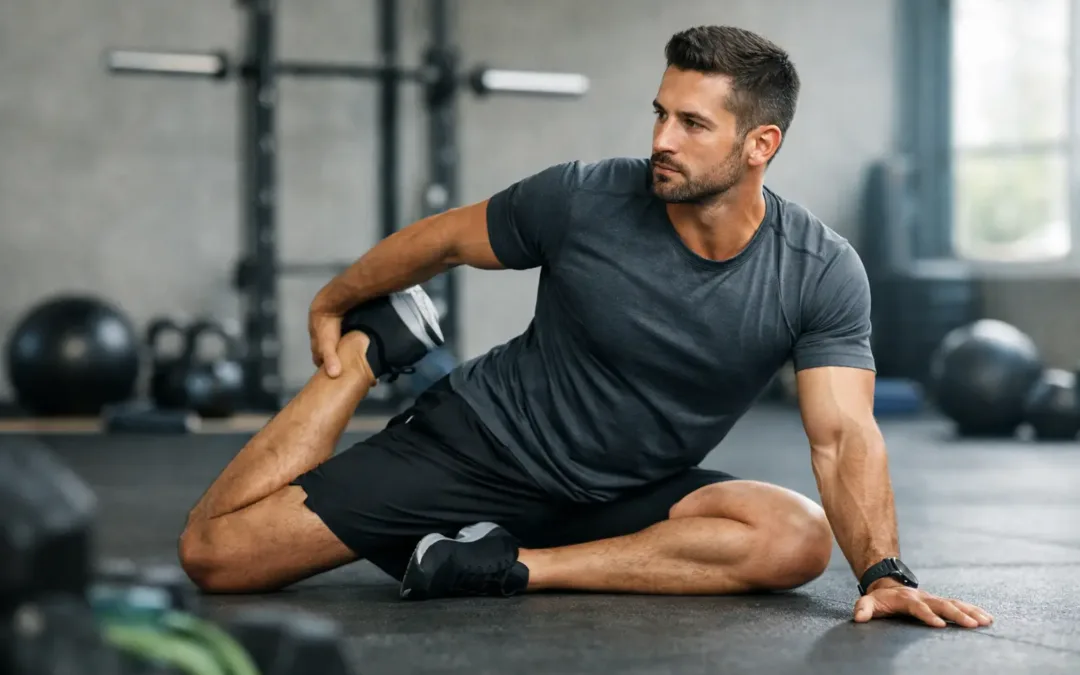
A stiff hip during squats, pinching at the front of your shoulder during presses, or a back that feels locked up after a long drive is not always a strength problem. Often, it is a movement problem. The best mobility exercises help you access the joint positions your workouts, workday, and recreational activities demand - with control, not just a temporary stretch.
For men who want to keep lifting, playing sports, carrying kids, and feeling capable as they get older, mobility work is a practical investment. It can make training feel better, improve exercise technique, and expose side-to-side limitations before they become habits. It is not a substitute for medical care or smart programming, but it is one of the most useful pieces of a long-term fitness plan.
Mobility vs. flexibility: know the difference
Flexibility is passive range of motion. For example, how far your hamstring can lengthen when you pull your leg upward. Mobility is the ability to actively control a joint through its available range of motion. You may be flexible enough to reach a deep squat position, yet lack the hip, ankle, core, or knee control to stay there comfortably under a barbell.
That distinction matters. Long static stretches can feel good and may improve flexibility, but a mobility routine should also train stability, coordination, and breathing. The goal is not to force your body into extreme positions. The goal is to own useful positions safely.
Men often lose daily movement variety as they get older. Hours at a desk, hard strength sessions, old sports injuries, and less recovery time can all contribute. The answer is rarely an hour of stretching. Ten focused minutes performed consistently usually beats an ambitious routine you quit after four days.
The 10 best mobility exercises for stronger movement
Use controlled reps, stay below sharp pain, and keep your breathing steady. A mild stretch, muscle effort, or joint stiffness is usually workable. Pinching, catching, numbness, radiating pain, or swelling is a reason to stop and get evaluated.
1. 90/90 hip switches
Sit on the floor with both knees bent about 90 degrees, one leg in front of you and one to the side. Without using your hands if possible, rotate both knees to the other side. Move slowly and keep your chest tall.
This drill trains internal and external hip rotation, two movements that matter for squatting, running, getting into a car, and changing direction. Do 6 to 10 slow switches per side. If the floor position is too demanding, place your hands behind you for support.
2. Half-kneeling hip flexor stretch with glute squeeze
Kneel with one knee down and the other foot forward. Gently tuck your pelvis by squeezing the glute on the kneeling-leg side, then shift forward slightly without arching your lower back. Raise the arm on the kneeling side and reach it overhead if that feels comfortable.
This is more useful than aggressively lunging forward because it targets the hip flexor while discouraging low-back compensation. Hold for 20 to 30 seconds, then repeat once or twice on each side. Men who sit most of the day often benefit from doing this before lower-body training.
3. Adductor rock-backs
Start on hands and knees. Extend one leg straight out to the side with the foot flat or toes pointed forward, then slowly sit your hips back toward your heels. Keep your spine neutral and return to the start.
Your adductors, or inner-thigh muscles, help stabilize the hip and knee. They are frequently ignored until a wide-stance squat, lateral lunge, or pickup game exposes the weakness. Perform 8 to 12 deliberate rock-backs per side, pausing briefly at the end range.
4. Knee-to-wall ankle mobilization
Stand facing a wall with one foot a few inches away. Keeping your heel down, drive the knee toward the wall and let it track over the middle toes. If you can touch the wall easily, move your foot back a little. If your heel rises, move closer.
Limited ankle dorsiflexion can make squats shallower, cause heels to lift, and shift more work into the knees or lower back. Complete 10 controlled reps per ankle. Do not force the knee inward to gain range.
5. Deep squat pry
Hold onto a sturdy support, such as a rack, countertop, or doorframe, and settle into the deepest squat you can control with your heels down. Use your elbows to gently press your knees outward, shift side to side, and take slow breaths.
This is a useful full-body position, not a test of toughness. Some men with long femurs, hip anatomy differences, or prior injuries will not have a textbook-perfect deep squat, and that is fine. Spend 20 to 40 seconds exploring a comfortable range rather than chasing depth at all costs.
6. Cat-cow with thoracic focus
On hands and knees, round your back gently as you exhale, then reverse the motion as you inhale. Instead of dumping the movement into your lower back, think about moving through the middle and upper back, where many desk-bound men become stiff.
Thoracic mobility supports overhead work, golf and baseball rotation, posture, and breathing mechanics. Do 6 to 10 slow cycles. Keep the range smooth; this should not look like an exaggerated contortion exercise.
7. Open-book rotations
Lie on your side with your hips and knees bent, arms extended straight in front of you. Keep the knees together as you open the top arm across your body, allowing your chest to rotate toward the floor behind you. Follow your hand with your eyes, then return.
This exercise separates upper-body rotation from lower-body movement. That is valuable if your lower back tends to twist excessively during swings, throws, or loaded carries. Perform 6 to 8 controlled reps per side and exhale as you rotate.
8. Wall slides
Stand with your back against a wall, feet slightly forward, and ribs stacked over your pelvis. Place your arms against the wall in a bent-arm position, then slide them upward as far as you can without shrugging hard, flaring your ribs, or losing contact completely.
Wall slides challenge shoulder flexion while teaching better scapular control. They are a strong choice for men who press, work at a computer, or notice tightness when reaching overhead. Aim for 8 to 12 slow repetitions rather than trying to force your arms into a perfect wall position.
9. Shoulder controlled articular rotations
Stand tall and brace lightly through your abs. With one arm straight, slowly make the largest pain-free circle you can: reach forward, overhead, behind you, and back to the start. Keep your torso still. Repeat in the opposite direction.
The slow pace is the point. This drill reveals where your shoulder loses control and helps you practice movement without momentum. Do 3 to 5 circles each direction per arm. If you have a history of shoulder dislocation, significant instability, or current pain, get individualized guidance before pushing range.
10. World’s greatest stretch, simplified
Step into a long lunge with both hands inside the front foot. Lower your back knee if needed. From there, rotate your inside arm toward the ceiling, then return your hand to the floor and gently straighten the front leg as your hips shift back. Move between those positions for 4 to 6 reps before switching sides.
Despite the dramatic name, this is simply an efficient combination of hip, hamstring, ankle, and thoracic work. It fits well before a full-body workout or a weekend sport session because it prepares several areas without taking much time.
Build a mobility routine you will actually use
Pick three or four drills that match your needs instead of doing all 10 every day. A lifter whose squat feels restricted may start with ankle mobilizations, 90/90 switches, adductor rock-backs, and deep squat prying. A man whose shoulders feel stiff after desk work might use cat-cows, open books, wall slides, and shoulder rotations.
Before training, use dynamic mobility for one or two sets of controlled reps. The purpose is preparation, so keep it brief and follow it with lighter warm-up sets of the actual lift. After training or on rest days, slower holds and longer breathing can be helpful if they make you feel better and do not aggravate symptoms.
Progress comes from consistency and strength in new ranges. If you gain more hip motion but never use it in split squats, lunges, hinges, or controlled squats, it may not carry over to the activities you care about. Pair mobility work with appropriate strength training, adequate sleep, daily walking, and recovery from hard sessions.
When stiffness needs more than mobility work
Not every limitation is tightness. Persistent pain, a joint that catches or gives way, major loss of range after an injury, night pain, or numbness and tingling should not be managed with internet exercises alone. A physical therapist, sports medicine clinician, or qualified physician can help identify whether the issue involves a tendon, joint, nerve, or another condition.
Start where you are, not where you think you should be. Five controlled minutes before your next workout can be enough to begin. Over months and years, that small habit can help you keep training hard, moving confidently, and showing up for the parts of life that demand more from your body.
This article contains general information about medical conditions and treatments. The information is not advice, and should not be treated as such. Click here for further information.