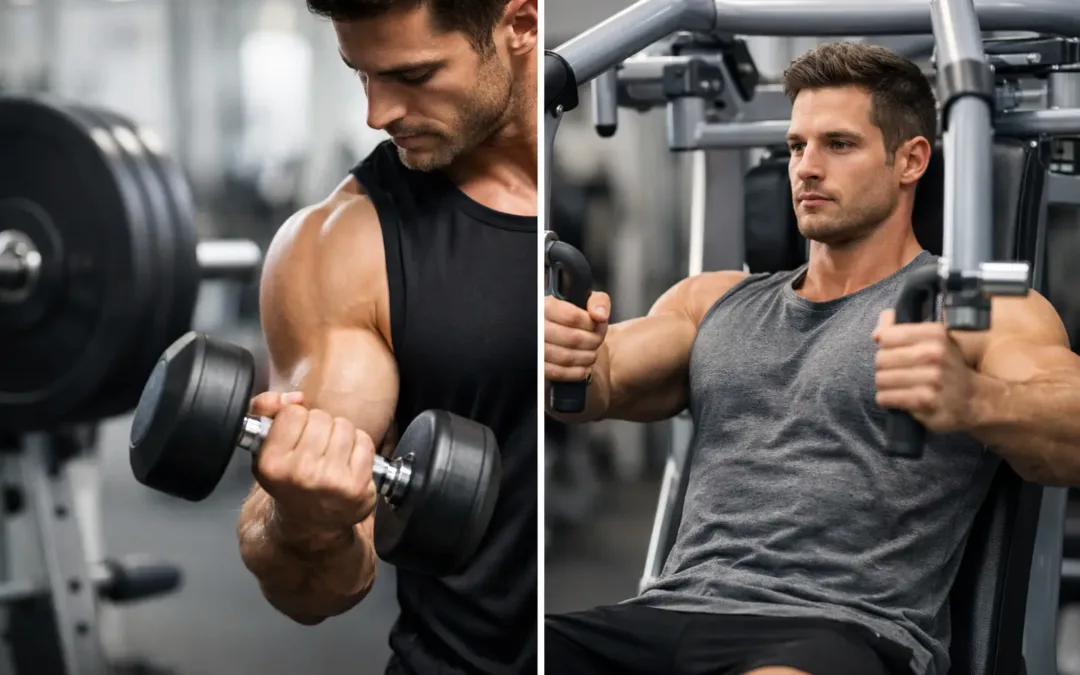
The free weights vs machines debate gets framed as if you have to pick a side. You do not. The better question is which tool helps you train hard, consistently, and safely enough to reach your goal - whether that is adding muscle, losing body fat, rebuilding strength after 40, or staying capable as you age.
A barbell squat can build serious lower-body strength. A leg press can let you push your quads close to fatigue without worrying about balance. Both can earn a place in a smart routine. Your experience level, injury history, gym access, and willingness to learn good technique matter more than gym-floor tribalism.
Free Weights vs Machines: The Core Difference
Free weights include dumbbells, barbells, kettlebells, and weight plates you move through space without a fixed track. Machines guide the resistance along a predetermined path, such as a chest press, lat pulldown, leg extension, or seated row.
That difference changes the demands of an exercise. Free-weight movements require you to control the load, stabilize your joints, and coordinate multiple muscles at once. Machines reduce the balance and coordination requirement, allowing you to focus more directly on the muscle doing the work.
Neither method is automatically superior for every man or every goal. Muscles respond to adequate training volume, progressive overload, solid technique, recovery, and enough protein and calories. The equipment is the delivery system.
When Free Weights Have the Edge
Free weights are highly useful when your goal is total-body strength and athletic capability. Exercises such as squats, deadlifts, presses, rows, lunges, and loaded carries train several muscle groups together. They also demand trunk stability and coordination that carry over well to everyday tasks, sports, and physical work.
A dumbbell press, for example, requires each arm to contribute independently. That can expose side-to-side differences that a barbell or machine may hide. Dumbbells also allow a more natural range of motion for many lifters, especially men whose shoulders do not feel great under a fixed bar path.
Free weights make it easy to get a lot done with limited equipment. A pair of adjustable dumbbells, a bench, and a few basic movements can support an effective home program. For busy men, that simplicity can be the difference between training consistently and skipping workouts entirely.
There is also a skill component. Learning to brace during a squat, hinge during a deadlift, or press without flaring your elbows builds body awareness. That is valuable, but it comes with a cost: technique matters. Poor form under a heavy, unstable load can turn a productive lift into an avoidable injury risk.
The limits of free weights
Free weights can be intimidating for beginners, particularly when the gym is crowded or no qualified coach is available. They may also be less practical when you are training alone near failure. Missing the last rep of a barbell bench press is a bigger problem than reaching failure safely on a chest press machine.
Some men also mistake free-weight training for a reason to chase maximum loads too soon. Strength is earned through repeatable, controlled reps over months and years. If your lower back, shoulders, or knees are sending a warning signal, forcing a movement because it is considered a classic lift is not toughness. It is poor judgment.
Why Machines Are Better Than Many Men Think
Machines are often dismissed as beginner equipment, but they can be excellent for muscle growth at every training level. Because the path is stable, you can place more attention on the target muscle and less on balancing the weight. That can make it easier to train close to muscular fatigue, which is a major driver of hypertrophy.
A machine chest press lets you challenge your chest and triceps without needing a spotter. A leg curl isolates the hamstrings in a way that compound lifts do not always fully cover. Cable and machine rows can train your upper back with less stress on the lower back than a bent-over barbell row.
Machines can also be a smart option for men returning after an injury, dealing with joint discomfort, or starting later in life. A fixed path does not guarantee safety, but it can reduce the coordination demands and make load progression more predictable. For a man over 50 who wants stronger legs without feeling unsteady under a barbell, a leg press, hack squat, or supported split squat may be the right call.
The limits of machines
The downside is that machines vary from gym to gym, and some simply do not fit every body well. A fixed handle position or seat angle may irritate your shoulders, hips, or knees. If a machine feels wrong despite adjusting the seat and setup, do not force it. Choose another variation.
Machines also do less to challenge balance and full-body coordination. If your entire program consists of seated and supported exercises, you may miss opportunities to develop real-world movement capacity. That does not make machines ineffective. It means they work best as part of a broader plan.
Which Is Better for Building Muscle?
For pure muscle growth, free weights and machines can both work extremely well. Research and real-world training experience point to the same practical answer: the best option is the one you can perform through a comfortable range of motion, progressively load over time, and take close enough to fatigue with good form.
Machines may have a slight practical advantage for isolation work and high-effort sets. It is easier to safely push a leg extension, pec deck, or cable curl near failure than it is to push a technical barbell lift to the edge. Free weights remain excellent for building mass through big compound movements that train multiple areas efficiently.
A productive approach is to use free weights for one or two foundational lifts, then use machines to add targeted volume. For example, a lower-body session might begin with dumbbell Romanian deadlifts and then move to leg presses, leg curls, calf raises, and leg extensions. You get the coordination and strength benefits of free weights while using machines to thoroughly train the muscles without letting grip, balance, or fatigue limit every set.
What Should Beginners Do?
Beginners should not feel pressured to start with complicated barbell lifts. The first job is building the habit, learning basic movement patterns, and understanding what controlled effort feels like. Machines can make that process less overwhelming.
Start with movements such as a machine chest press, lat pulldown, seated row, leg press, leg curl, and cable or dumbbell shoulder press. Add simple free-weight exercises as confidence grows, including goblet squats, dumbbell rows, dumbbell presses, and farmer carries. These movements teach control without requiring you to manage a heavily loaded barbell from day one.
Use a weight that lets you complete roughly 8 to 15 controlled reps while leaving one to three good reps in reserve. When you can reach the top of that range with clean form, increase the load modestly. This is more effective than changing exercises every week or testing your max strength before your body is ready.
Training After 40: Put Joints and Consistency First
Men over 40 can build muscle and strength very effectively, but recovery, previous injuries, sleep quality, and joint tolerance deserve more attention. You may still love barbell training. You may also find that your shoulders feel better with dumbbell presses and cables, or that your knees prefer a leg press to heavy back squats.
That is not a downgrade. Training is supposed to support your life, energy, confidence, and long-term health. The best exercise is not the one that looks most impressive. It is the one you can repeat pain-free, progress patiently, and recover from well enough to show up again.
Pay attention to sharp pain, joint swelling, numbness, weakness, or pain that worsens after training. Normal muscle fatigue is expected. Persistent or concerning symptoms deserve an evaluation from a qualified health professional, especially if you have a history of surgery, arthritis, heart disease, or uncontrolled blood pressure.
A Smarter Way to Use Both
Think in terms of purpose. Use free weights when you want to practice movement skills, build broad strength, and train efficiently with limited equipment. Use machines when you want stability, muscle-specific work, safer hard sets, or a way to train around an irritated joint.
A balanced routine does not need to be complicated. Two to four strength sessions per week, built around a few compound movements and supported by targeted machine or cable work, is enough for most men to make meaningful progress. Pair it with daily walking, sufficient protein, quality sleep, and reasonable stress management, and the benefits reach far beyond the mirror.
Do not let equipment preferences slow you down. Pick the exercises that fit your body, train them with intent, and keep enough in the tank to come back stronger next week.
This article contains general information about medical conditions and treatments. The information is not advice, and should not be treated as such. Click here for further information.