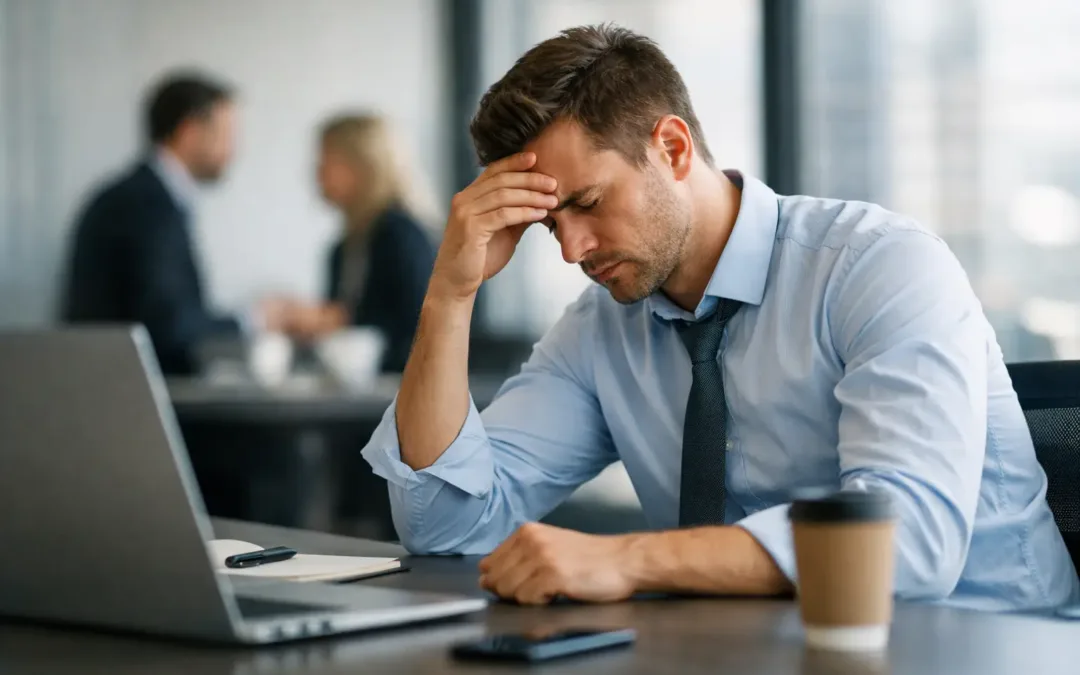
Your body usually gives you the first warning. Tight chest. Shallow breathing. Racing thoughts. Maybe you're about to give a presentation, step into a game, or have sex with someone you care about - and suddenly your confidence drops through the floor. If you're trying to figure out how to reduce performance anxiety, the goal is not to become fearless. The goal is to stop pressure from hijacking your body and your focus.
Performance anxiety is common, and for men it often hits in areas tied closely to identity: sexual performance, work competence, athletic ability, and social confidence. That can make it feel more personal than ordinary stress. But the same basic pattern is usually at work. You start monitoring yourself too closely, your nervous system shifts into threat mode, and the very thing you want to do well becomes harder to do.
Why performance anxiety happens
At its core, performance anxiety is a stress response. Your brain reads the moment as high stakes. That might be because you care deeply, because you had a bad experience before, or because you believe one mistake will say something permanent about you.
Once that alarm goes off, your body prepares to protect you, not perform smoothly. Heart rate rises. Muscles tighten. Breathing gets faster. Attention narrows. That can help in a real emergency, but it works against you when the task requires coordination, connection, timing, or arousal.
This is why anxiety can affect sexual performance so strongly. An erection depends on relaxation, blood flow, and arousal. Anxiety pushes in the opposite direction. The more a man tries to force the result, the worse the cycle can get. The same thing happens in sports and public speaking. Overcontrol interferes with natural rhythm.
There is also a mental layer. Many men deal with all-or-nothing thinking: If I mess this up, I'm weak. If I lose my erection once, it means something is wrong with me. If I choke in one meeting, people will never respect me. Those thoughts add fuel to the physical stress response.
How to reduce performance anxiety in the moment
The fastest way to lower performance anxiety is to stop treating the moment like a test of your worth. That sounds simple, but it takes practice. You are trying to shift from self-evaluation to task focus.
Start with your breathing. Slow, steady exhaling tells your nervous system that you are not in danger. A useful pattern is breathing in for four seconds and out for six to eight seconds for a couple of minutes. The longer exhale matters more than taking huge breaths. If you breathe too hard, you can make yourself feel more amped up.
Next, relax the body on purpose. Drop your shoulders. Unclench your jaw. Loosen your hands. If your body stays braced, your brain keeps reading the situation as threatening. A small physical reset can interrupt the spiral.
Then narrow your attention to one simple cue. In sports, it might be your footing or your follow-through. During sex, it might be touch, breathing, or connection with your partner instead of checking whether you're staying hard. In public speaking, it might be delivering one clear sentence at a time. Anxiety gets stronger when your mind is split between doing the task and grading your performance in real time.
It also helps to change your internal language. Saying I need to crush this creates pressure. Saying I just need to stay present lowers it. That is not soft thinking. It is efficient thinking.
How to reduce performance anxiety long term
If performance anxiety keeps showing up, you need more than a pre-game trick. You need to lower the conditions that make your nervous system overreact.
Sleep is a major factor. Poor sleep raises baseline stress, hurts mood regulation, and makes it harder to recover from setbacks. If you're consistently underslept, your body is already closer to the edge before the pressure even starts.
Caffeine can also be part of the problem. Some men tolerate it well. Others mistake caffeine overload for confidence until it turns into jitteriness, a racing heart, and tunnel vision. If your anxiety spikes before sex, competition, or speaking, look honestly at your intake.
Regular exercise helps, but not only because it burns off stress. Training teaches your body that elevated heart rate and physical activation are manageable. It also improves confidence in a grounded way. Still, there is a trade-off. Too much intense training without recovery can increase fatigue, irritability, and anxiety.
Mental rehearsal works too, especially if you do it realistically. Picture yourself entering the situation, feeling some nerves, and then settling into the task anyway. That is better than fantasizing about a perfect outcome. Your brain responds well to familiar patterns. The more often you rehearse calm under pressure, the less foreign it feels.
Sexual performance anxiety deserves direct attention
For many men, this is the version that hits hardest. Sexual performance anxiety can show up as trouble getting or maintaining an erection, reaching orgasm too quickly, or feeling disconnected and tense during intimacy. One difficult experience can create a loop: fear of it happening again becomes the reason it happens again.
The first move is to stop framing sex as a pass-fail event. That mindset puts your body under surveillance. A better approach is to shift focus from proving performance to sharing an experience. Pleasure, touch, pacing, and communication matter more than trying to force a specific result on demand.
If you're with a partner, say what is happening in plain language. That can feel uncomfortable, but silence usually makes anxiety worse. Many men assume they have to hide it and push through. In reality, honesty often lowers pressure immediately.
Lifestyle factors matter here as well. Alcohol may seem like it takes the edge off, but it often makes erections less reliable. So can poor sleep, smoking, sedentary habits, and high stress. In some cases, sexual performance anxiety overlaps with a medical issue such as low testosterone, cardiovascular problems, medication side effects, or erectile dysfunction that is not purely psychological. If the problem is frequent or worsening, getting checked out is smart, not dramatic.
When your thoughts are the real trigger
Some men are not mainly dealing with the event itself. They are dealing with the story around it. They rehearse failure before anything has happened. They compare themselves to other men. They assume every setback means decline, weakness, or embarrassment.
This is where cognitive reframing helps. You do not need fake positivity. You need a more accurate interpretation. One bad night does not define your sex life. One rough presentation does not mean you're not capable. Pressure can affect anybody, especially when something matters.
A useful question is: What am I actually afraid this will mean? Often the fear underneath is bigger than the moment. Maybe it is aging. Maybe it is rejection. Maybe it is not feeling enough. Once you identify that deeper fear, your response becomes more targeted.
If the pattern is deeply ingrained, therapy can be worth it. That is especially true if anxiety is affecting relationships, work, or self-esteem. Cognitive behavioral therapy, exposure-based strategies, and sex therapy can all help depending on the situation. Asking for support does not make you less self-reliant. It helps you stop wasting energy on a loop that is holding you back.
Habits that quietly make anxiety worse
Men often look for one dramatic fix while missing the daily habits that keep anxiety alive. Constant self-comparison is one. So is relying on pornography in a way that trains arousal around novelty, intensity, or unrealistic expectations. That does not affect every man the same way, but for some, it can make real-life intimacy feel more pressurized.
Another issue is avoidance. If you back away from every situation that makes you nervous, relief comes fast, but confidence shrinks. The better move is graded exposure. Face manageable levels of pressure, recover, and repeat. Confidence grows from evidence, not pep talks.
It is also worth checking whether your standards are realistic. High performers often assume pressure means they care. Sometimes it just means they have tied their identity too tightly to the outcome. Ambition is useful. Perfectionism is expensive.
A better way to measure progress
If you want to know whether you're improving, do not ask whether you felt zero anxiety. Ask whether you recovered faster, stayed more present, and kept going without spiraling. That is real progress.
You may still feel nerves before sex, before a game, or before a big conversation. That does not mean the tools are failing. It means you are human and the moment matters to you. The win is being able to function well without needing perfect calm first.
That shift is what gives you back control. Not the fantasy of never getting anxious again, but the ability to perform, connect, and think clearly even when some pressure is in the room. Start there, stay consistent, and let confidence be something you build rather than something you wait to feel.
This article contains general information about medical conditions and treatments. The information is not advice, and should not be treated as such. Click here for further information.